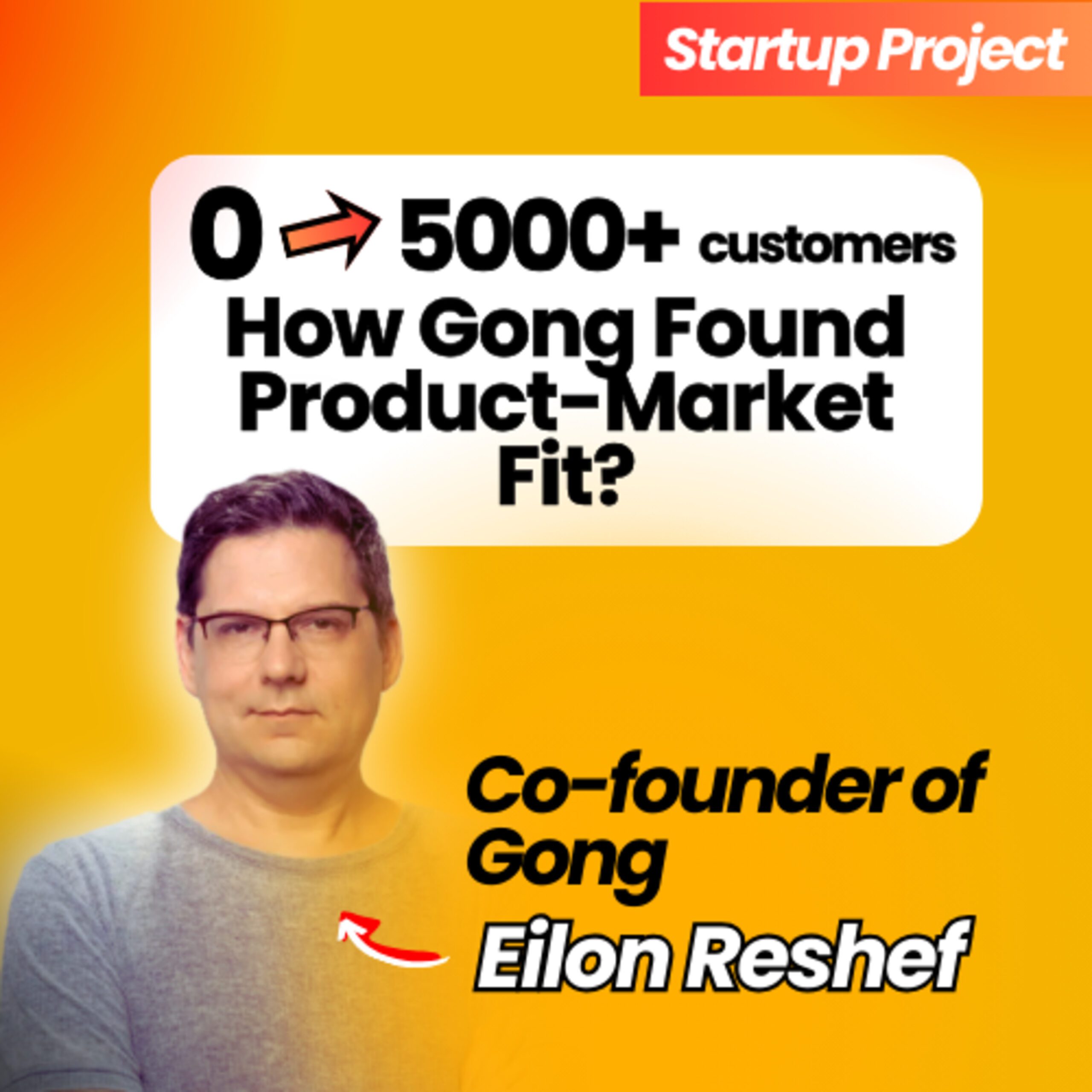
This page contains the readable, near-verbatim transcript from this Startup Project episode.
- Guest: Eilon Reshef
- Company: Gong
Full Transcript
Nataraj (00:01.87) Hello everyone, welcome to Startup Project, where we deep dive into the minds of innovators and entrepreneurs that are shaping the future of tech. My guest today is Ilan Reshaf, the co-founder and chief product officer of Gong.io. Before co-founding Gong in 2014, he was already a seasoned entrepreneur, having co-founded and led WebCollage, a successful SaaS platform, which was acquired in 2013.
Gong leverages advanced AI to analyze customer interactions and sales conversations and enables teams to boost their productivity, deliver revenue predictably, and drive efficient growth. Under Elon's leadership, Gong has evolved from initial conversational intelligence offering into a sophisticated, derivative AI operating system. It reunifies customer insights through proprietary Gong revenue grasp, diverse actionable intelligence, and automates critical workloads.
have over 5,000 customers, including prominent names like DocSign, PayPal. Gong's impact is unbind and deniable. It helps companies achieve outcomes like 57 % higher win rates and saves thousands of operational hours. Today, we'll explore the genesis of Gong, how they achieve product market feed, and how AI changed their business and product, and a lot more other interesting things. With that, Elan, welcome to the show.
Eilon Reshef (01:26.306) Thanks for having me.
Nataraj (01:28.155) So I think the first question I wanted to ask was what was that initial problem that sort of like caught you and your co-founders attention that led to GUNS?
Eilon Reshef (01:40.768) It's a good question. And actually Gong is one of those boring companies where not much has changed in terms of the overall vision from when we started and today, despite all of the revolution that happened within the technology world, obviously LLMs and whatnot. When we started, that was about 10 years ago, 2015. And at the time, we're looking at the revenue space.
And what we noticed was people were, it was treated like an art, right? Sales is art. And we felt strongly that if you can introduce a time, we didn't even call it AI, was data science, data-driven workflows, whatever you want to call it. You can make things much more efficient. again, today everybody's talking about productivity and AI, same idea. And then we realized that in order for quote unquote AI to make sense and help.
First of all, you have to have like quality data, which hasn't changed. AI is only as good as the data it gets. So what we started as a company was let's capture the core information, which some people might think is the CRM, but in reality, it's actually the conversations that people have with customers. So it could be sales, sales could be post sales, be sales engineers, SDR, whatever. And the idea is if AI has access to those conversations, then we can start making like really, really good decisions, recommendations, and actually carry out actions for you. So that's exactly what we started.
At the time, we kind of hooked up to WebEx. That was our first video conference system. Zoom was barely starting. And then later we did email and text messages and other data sources, and of course, connecting to CRMs. But the core genesis was let's bring information, put it in some sort of, and we call it a revenue graph, some sort of a graph system, and then apply logic to it to help people be more productive and leaders get more intelligence.
Nataraj (03:21.805) think in some sense a lot of these ideas are now a little bit more common.
But I think back then it was not that common. Getting all the call data and transcribing it was not really native to any of these, if you're using Zoom or anything. Transcription was not native. recording calls was native, but we didn't transcribe calls. Even if you use Teams or Google Stack, transcription and getting that data and analyzing that data was not really common. Now there's a lot more competition in that space. What was the tech stack?
for when you are using, you're trying to solve this problem.
Eilon Reshef (04:01.282) It's a very good point. Even the idea of recording at the time, people did not want to invest in Gong back in 2015. I mean, obviously we did raise money, but most of the majority of VC firms did not want to invest in Gong because their hypothesis was people will not want to get recorded. Which was of course right now we're entering 2026 and obviously it almost feels like ridiculous at this stage, but it wasn't obvious at the time. And what we had to do was actually invent or develop the core recording technology because most providers
I don't could not record even calls even if they did it was some clumsy process where maybe a user had to manually click record which of course wouldn't So we started with technology stack that's basically developing a bot that joins the calls now It's so common that yeah, sometimes if you're meeting like four people and an 18 pots or whatnot But at the time we still have a patent on what's joining call. So we developed this back in 2015 And it's joining the calls. It's sort of the automation around starting recording capturing the screen whatnot, of course keep bringing it to the back end of
Of course, it was a robust kind cloud first, you know, kind of system to begin with, 2015 modern stack. And then in the beginning, we used the third party transcription engine, which really, really sucked at the time. It wasn't because of the system. It was just because technology in 2015 was like, I think something like 30 % word error rate, which means three out of 10 words are actually wrong. So you can even read the transcript. The first versions of GoG, we essentially hit the transcript beyond like four clicks so people wouldn't find it. You could still search it and do statistics and like high level topic detection.
but like reading it was really really hard and then very quickly moved to a homegrown system which was better and of course nowadays we still use a homegrown system but it's much more much easier to just kind of I don't know take whisper or any of the major providers transcription off the shelf and then kind of use it and get I guess pretty good results.
Nataraj (05:50.319) Who were the early customer adopters? you mentioned like, transcription would be not that great, but like who, which type of customers really leaned in on this?
Eilon Reshef (06:01.778) Yeah, so I'm a big believer in sort of the crossing the chasm, me and my founder both are big believers in crossing the chasm model, which means you want to start with a very small niche. And so when we started, we basically said, who's adapting technology fast? It's like technology companies, good. Which technology companies are more likely to use video conferencing? Like guess what software companies, because they don't want to travel to.
you know, destination because software it's like easier to sell software online and physical goods. then, so we pretty much said, Hey, and enterprise we couldn't sell because we didn't have like a way to set to enterprise. was just like, we didn't have security. didn't have scalability. So we said, let's start with software as a service companies in the United States of America, North America, selling in English over video conferencing, midsize companies selling midsize ticket items. Because if you're just selling, I don't know, $5, you probably the conversation is not as
important to you. Maybe even the wholesale cycle is more like a B2C type of thing. And then if you're selling, I don't know, if you're buying and selling airplanes, my guess is you're probably not going to have, like you're to have much more a relationship selling and in-person selling, which at the time we couldn't support. So the idea was like, focus there.
And then afterward we said, hey, it's not only video conferencing, it's phone conferencing. And then you pick an email and then you can start doing more relationship understanding. And then you can have like, now we have an in-person recording and all sorts of other things. But the idea at the time was like, focus, focus, focus. There's probably 10,000 companies in the world that focus on this category.
But look, to get from seed round to A round or to B round, whatever, you only need like a dozen, two dozen customers. As long as you know there's enough companies in the future, we're very satisfied. And just like starting with a very narrow customer base.
Nataraj (07:45.007) What kind of early insights was gone providing at that time, like in 2015, 16, whereas adopting, because prescription itself was not accurate, what does was actually find valuable?
Eilon Reshef (08:00.49) Yeah, so if you think about what can you do with this transcription that is not accurate, it almost lends itself to what are the killer apps for this. And one killer app was Search.
So even if you don't, like some words are missing, you search for a competitor, you still find them. So we invented this idea called a tracker, which still by the way is available in every Gong, I don't know, wannabe or even like a big, actually even Microsoft has some sort of a conversation that is this product that actually even use the word tracker inside it. And the idea was the tracker was like a saved search or a saved keyword list.
And then what you could do as an organization say, hey, I want to focus on those conversations that actually use, you know, bring up competitor X or challenge Y or technology Z or whatever. And then you can program the system for this to kind of drive many, many workflows. One is just like, I'm a product manager. want to know what's happening in the field or very common use case. I'm a sales manager. want to coach people, but I don't want to coach them on every call. want to call it just like talks about pricing. Or I want to help my team.
position against the competitor and I want to find only conversations that are about the certain competitors. So search was a phenomenal use case or narrowing down filtering this side.
you know, very big graph is sort of like super important. The other one is more of a collaboration use case, which is I'm a salesperson. I got asked the question, I need to bring in more people in the loop and I can start tagging people and just having a very convenient interface where you can bring more people to collaborate. There's a chat window, there's you know, kind of mark moment 27 and it's making it very easy to people to kind of.
Eilon Reshef (09:44.254) send as a team and that was a very use case. So these are maybe the two main ones, one more AI, one less AI maybe.
Nataraj (09:51.375) And when was like that sort of like tipping point where you thought, okay, we've achieved product market, but was it like very early on or like a couple of years into the development of the product?
Eilon Reshef (10:03.106) Yeah, that's one of our funnier stories in Gong. So this is going to be like maybe two different answers. So one is when should we have realized that we product market feed and then maybe, you know, us being a little bit slow when we actually realize it, right?
So the point when we should have realized it, we raised money in October of 2025. I brought some of the team members who worked with me in my previous life. So January, three months in, we had like a running prototype that could record many calls and transcribe them and do all of the things we just discussed. So we started giving it to customers, again, alpha, beta customers, whatever, just like SaaS companies, know, kind of our size. I mean, not like five people, but whatever, 500 people, maybe 1000 people. And then we gave it to 12 design partners and we
them, could you please give us feedback? And they started complaining and we fixed things. Of course, nothing worked in the beginning. And then at some point they stopped complaining. And then when they stopped complaining, we were like, why are you stopping complaining? And we watched obviously their behavior and they're like, we're using it. It's fine. Why are we complaining? And then I meet my co-founder basically said, what if they are not complaining and are using it? Maybe we start asking for money. Right. So we had 12 design partners. We called them and said the beta is over. There wasn't any beta, right? It was just like, we just gave them the software to try it out. Right.
And then 11 out of the 12 paid and that was like May 2016, which is six, seven months into the company, right? And 11 out of the 12 actually went ahead and paid. And we weren't cheap at the time. were like charging initially maybe 750 per individual per year. like this price now is higher, but you know, for a young startup with a dozen employees, that's not small, right? And 11 out of the 12 paid and then the 12 actually paid a year later. I mean bought a year later, the CROs changed jobs and like they couldn't buy.
And I think that's probably a point where you should stop and be like, shit, this thing is actually working. Cause like 11 out of 12 is like unreal in a way. But we're like, okay, that makes sense. Let's maybe, I don't know, why isn't the 12th buying? And then maybe it's time to hire for a sales rep. But that was definitely the moment where had we been more maybe kind of attentive to the process, we would have said, hey, this is a product market for moments.
Nataraj (12:08.526) The first time I actually sort of encountered Gong was in 2018-19. I was doing a pitch deck for an Indian company trying to do software for customer support and sort of trying to do similar things of like, you know, collecting all the transcription and trying to improve the efficiency on a call center level, primarily targeting, you know, food delivery companies.
And then I was evaluating who are the bigger players internationally who are already doing some version of this. And that's my first encounter of Gong. And since then, I kept tracking of what is Gong doing. Can you talk a little bit about what types of different customers are using Gong? Because I can easily imagine all the enterprise sales organizations.
but what are the types of customers you generally can sort of categorize them into.
Eilon Reshef (13:07.115) I would say these days, obviously, the Gong has evolved from Wudang.
we started using kind of conversation intelligence and then revenue intelligence, which we added more capabilities. I'll touch on this a little bit in second. And then now kind of we call it AIOS for every teams. And obviously as the, as the sort of the capabilities were strengthened, also the types of customers that you can serve is growing. So the type of capabilities we added is pipeline management, forecasting, sense engagement, which is prospecting, coaching, enablement, these sort of things. So as you expand those suddenly more and more companies need, they might not need a whole shop bank. They might not be doing,
forecasting using software, but this might still be prospecting over software or coaching using software. So nowadays, I'd say we serve companies anywhere from a small company of like 50 people all the way up to the world's largest organizations. Five out of the top fortune 10 companies are gone customers. Cisco is one of our kind of, you
public references, they are deploying it to 20,000 sellers, which I think is the largest revenue I deployed in the world, I don't know, but obviously large scale as well. So I would say nowadays it's less, the industry we're much more diverse now, so there's financial services companies, there's healthcare companies.
of course, technology companies, even like telecommunication companies, AT &T and such. And then nowadays we also cover, people think of Gong sometimes as selling, but we really kind of try to help everybody along the customer journey for anybody who's creating pipeline prospecting in tech, it's called SDRs, selling team pre-sales, solution architects, whatnot, implementation, post sales, people responsible for retention and expansion. And then sometimes it's
Eilon Reshef (14:56.003) of the more strategic level even product managers and sort of like non revenue related. So if you sort of look at these type of personas almost every company in the world has them. We're still a lot of our business in North America just as this is where we started. Still a lot of our business maybe 50 % is still tech or tech related just with this where we started but very diverse nowadays.
Nataraj (15:17.966) What do you think about this idea that anyone can build for wipe code or stuff like that? We're sort of seeing the commoditization of writing code in that era. Getting an MVP version of Gong might be easy.
are easier than what it would be like eight years or nine years back when you started. Then we are seeing transcription software companies everywhere. There's so many of them. But my general question is how do you look at the commoditization of software in that scenario? What is the edge? What is the mode? How do you approach just building companies? You are an established player, but someone who's starting now, how would you think?
What are your general thoughts on this?
Eilon Reshef (16:08.097) Yeah, maybe I'll answer that a little bit at a zoom out level and maybe even a little bit provocatively, right? I think we are, as a universe, we're a little bit in a sort of a, you know, post-truth world. And what post-truth means also is you get a lot of incentive of just like coming up with very bold, not necessarily true claims because they get you publicity and sometimes recognition. And the press loves this because it gets them whatever call them clicks, right?
I think some of the discussion around like, we're going to vibe code everything kind of comes from.
There's the idea of, what if I just told you AI is going to make your engineers 30 % more effective? This is boring, right? Who cares about 30 % more effective, right? So now people are much more excited about talking about maybe engineers is going to go away. Maybe the PM can code. Maybe there's no need for SAS. I think these are widely exaggerated. think AI is phenomenal for engineering productivity. I don't know if it can save. I don't think anybody is saving even 50 % these days, but I think 50 % is within reach. 10 % people are getting today.
I think maybe even more. And I think it's really good for software companies. It's good for the universe because you can get more value by getting more software. I think, yes, you can definitely do LavaBull or use any other tool for prototype very, very quickly. But once you want to get like real software with all of the infrastructure, security, functionality, iterations, enterprise quality software.
Yes, it could be cheaper, but I don't see majority of functions going away. And then you also need salespeople to sell it and you need marketing people to market it. 100 % sure you can do it more effectively, but I don't think that fundamentalist change. I also don't think that organization should be bothering with.
Eilon Reshef (17:52.384) I don't know, coding their own software, they're get into the same cycle of like, gotta maintain it, I gotta change it, it's not working, who's gonna support it? Same challenge that people have had for maybe 40 years, don't know, 30 years for sure, which to me, like, doesn't make any sense,
Nataraj (18:07.468) Yeah, mean, think the people who try web coding is you can get into production, but…
once you get into production and people start asking, want this, I want that, and I want to improve this, and then you don't know what you have written, then maintenance and improvement really becomes a challenge. But that's actually probably what he said is right in terms of the post-truth one. It's easy to make an exaggerated claim and discuss it and promote it. I think it has a morality inherent built in it.
and which everyone is craving for.
Eilon Reshef (18:49.215) Yeah, I'll even say more. Now I'm going to insult a little bit my VC friends here, but you know, since, I mean, we are on record. I mean, I'm not going to beat me for it, but I sometimes tell our marketing people when they read some of those very, very bold claims. If you see them coming from VCs, for example.
mean, Gong does content marketing, right? We tell people about how sales should behave because we assume that if people read about how sales should work, eventually they're going to look and see who Gong is and then maybe they come to us as customers or as prospects. Right? Everybody else got the marketing. VC is content marketing, which is used for deal flow, right? It's basically come up with very, very bold claims about AI because that gets you the very eager entrepreneurs. So I think it should also like reverse engineer who says one into what are they kind of, are they actually writing objectively or is there a goal behind it?
all be more particular about how we interpret what's written out there in the media because that's the 2026 work, right? We can't change it, we can just be more aware of it.
Nataraj (19:47.535) Talk to me about this, you know, from conversational intelligence to this, now you call yourself as like a revenue operating system, AI revenue operating system. Like, what is the difference, you know, what are the features that make it different?
Eilon Reshef (20:03.881) Yeah, so when we started the whole notion was we're to start with analyzing a single conversation. And there's lots of stuff to be said about a specific conversation. Did you set up next steps?
Did you just talk yourself to death? The gong is probably invented to get you off measuring a talk ratio for the rep, right? Should be obvious, but people say there's a reason why we have two ears and one mouth. You should just listen more than talk. But there's so much value it can bring by just focusing on the conversation. So very quickly in the road, we said we don't want to be the experts in how to handle a specific conversation. That might be good for consumers and support over the phone. We want to help people really kind of realize their full potential in terms of being
revenue professionals and revenue organizations. So we started understanding what are the key workflows that people have within revenue organization and started rethinking about them in what I would now call AI before it was just like data and data science ways. So I'll you an example. Every revenue organization on earth, there's some sort of a cadence where somebody reviews their pipeline and decides what to do next. Sometimes it's the rep, sometimes it's a one-on-one meeting, sometimes it's a big forecast call, right? So we said, what does this process look like in an AI-centric world?
AI actually shows you which deals are more relevant than others. So it shows you, have you had a conversation, what was said in the conversation, when an event came out, you can ask a question about that deal or account or whatnot. And then it summarizes for you and it just helps you kind of do that job. So we gradually built more and more workflows. So revenue intelligence and then revenue AIOS is basically a pipeline management. And then we grew this to forecasting. What if AI can help you focus where you are, which is super important.
And then we took another key workflow, which is making people better. So we have an enablement product that says, hey, I'm going to actually help you coach the team. And of course, nowadays AI can actually coach for you to a certain degree, right? Score calls, understand the facets. And then now we're launching a trainer, AI trainer, which is going to talk with you and help you simulate the customer and coach you, right? So this is another angle. And then we looked at how do you prospect? And the idea is like, what if you can prospect to people, but actually leverage your history with the accounts and be like, yeah, AI is going to write the emails for you. It's going to do most of the…
Eilon Reshef (22:09.123) majority of the boring work for you, right? So as you look at all of those things together, if you're a revenue organization, be like, yeah, I want a single platform that does all of the things for me. I don't want reps to kind of go between systems and a different data layer that I need to sort of reconcile and then have several contracts and whatnot. then, Gong nowadays is the position where we're like, yeah, we're a single OS for everybody. So you're still gonna need like a CRM. You might still need some sort of data from somewhere and other things. It's not like, I don't think there's a single contract
in the world where you could just use that company's products and nothing else. But it is a sort of a central place where revenue professionals and leaders can do the majority of their high quality work nowadays. And of course more comings.
Nataraj (22:54.126) You talked about AI training or coaching. You also mentioned like in the starting of our conversation, sales is sort of like an art. Does the coaching really make or give you the best salesperson?
Do you see that pattern as an outcome or are you saying that if someone is 50 % effective, now we making them 80%, but really the 80 to 20 is still hard? What is your take on that?
Eilon Reshef (23:24.865) Yeah, so there's effectiveness and efficiency both contributed productivity efficiency I does this all the time perhaps you write an email and all of these things just takes takes time off Effectiveness on is more subjective in some ways because how can you prove that somebody's better Gong has been I think traditionally we've been able to show that you can move the curve
You're not going to make the excellent people, excellent plus plus. Yes, you have them around 10 % for sure, but like they're already excellent. You're never going to make the C players A players. This is not going to happen, but you can make the C player C plus, the C plus B and B is the A's kind of thing. So you see the whole curve moving and you see it pretty consistently. You just learn new skills, things they weren't aware of and just become better. I don't think you can expect everybody to be an A player. By the way, you should also replicate the A players. If you're going to try to shoot a three pointer for more.
like Steph Carey, you're just not gonna make it because you know, he shows from I don't know wherever, like weird places. You should probably, you know, you can do better than what you're doing right now, but the A, like the A plus players sometimes have such a unique pattern that you don't even wanna replicate it.
Nataraj (24:28.846) I think Gong is also the intersection of this, I would assume, like some sort of AI agent phenomenon that's happening. I've seen a lot of demos and products out there, which are sort of AI taking a call for the customer and sort of doing better or sometimes same quality output.
What is your general take on that kind of sort of like when AI is actually talking to customers and now AI agents basically taking over real sort of responsibilities? Like where are we in the curve of like an option of those kind of farm factors?
Eilon Reshef (25:11.841) We're getting close. I don't think those AI agents are going to replace a B2B setter. Most of the customers are B2B setters. There's an element of relationship. There's an element of knowledge. There's an element of just continuously understanding what's going on with your customer. AI, customer-facing AI can do a…
sometimes a good job in sort of like especially like one and done B2C phone calls, know, kind of anywhere from like a glorified IVR to just like, hey, let me qualify a little bit and sell you something. This is already happening. I think the equivalent in B2P might be inbound leads, especially ones that you don't have capacity to deal with. And the other thing is, this is kind of where I think the market will be heading is
Outdoor specific tasks from your day. So let me give you an example, right? I'm a salesperson and I want to walk my customer through my proposal, right? As an example, right?
you can send the quote-unquote agent to do this for you. If the agent's been trained enough to sort of understand what does your contract look like and trained enough to understand what the customer need, they can probably do a reasonable job in walking you through the contract, saves you like 30 minutes, and to be honest, probably the customer's gonna be happier, because now they can do it whenever they want, like 6 a.m. Pacific, you know, whatever the thing, 6 a.m., whatever, some time where the rep is not even available. So I think it's gonna be carving out those tasks, making sure that you can train
the agent to do a good job for this particular task versus everything and chop away pieces from the rep's work. I think the way we're looking at it, what's really nice about it is when we're starting to provide those things, including the trainer, the way, we train the system based on actual conversations. So we go, have a tool called AI Builder, which basically says, hey, let me look at historical patterns, identify what's working, build me something. It could be a document for humans. It could be a script for agents.
Eilon Reshef (27:10.945) and we like take based on that, which is really huge because if you started like program this from scratch, you're probably not going to get much. And then how are you going to conceive of all of the issues? It's going to take a month and a month of training. Whereas if you have all of this history, you can very quickly like iterate.
Nataraj (27:24.908) mean, it's also possible like if I'm purely dealing with customer support calls, know, hey, I'm trying to do a refund or like a very specific small problem. think it's.
much easier for someone like you who has all the training data available to create an agent targeting a specific problem. And every time a customer asks some type of question, you can route it towards that particular agent. I think that's a pretty possible scenario that I can see playing out. Do you have any thoughts of how this AI agent space will evolve? The AI agent space evolve?
Eilon Reshef (27:57.088) Big what, sorry?
Eilon Reshef (28:03.137) How will it evolve in the future? I think it will gradually take away, start from…
taking away very specific, like you and I mentioned, right? Just like start taking away those tasks that are very specific, you know, like you said, ask for refund or help me understand how my account works or maybe helping book-driving for all I know, and then gradually take more and more and more responsibilities. It might take away some of the…
maybe kind of more junior jobs, which, you know, kind of AI usually is where it shines. And then outsource pieces of the more advanced jobs. So even if you're a B2C seller, B2B seller, sorry, and you're selling very high end equipment, you might still use an AI seller as like a sidekick. Go for it. Hey, go do this for me, especially if it's certainly, you know, tasks and chatbots and whatnot for sure. But even like go talk to the customer about this particular thing and then send them off. It's not a high,
It's not a critical conversation and it's focused and it's like repeatable. So you were able to train some of the AI on it. You'd probably be able to do it with AI, right?
Nataraj (29:18.68) Do you see, so one of the patterns that I've seen is like companies that are really benefiting from.
you know, like post-HGPT sort of like the breakout, know, LLM usages, companies which have been in the play targeting a specific sector, they've already, you know, have great software. Now they can use AI to build and like sort of compound that which you sort of like fit in. Like, is that what happened when you first like saw LLMs coming out popular? I'm assuming like you were much more closer to the ecosystem. But what was your thought when like, I think in 2022 or
when our chat GPT came out, like, did it realize like, okay, now we have a really advantageous position, like what were your thoughts when that happened?
Eilon Reshef (30:05.227) So first of all, we have been using GPT 3.0 even before ChatGPD, had our own models to generate next steps. You can believe it, like we had the next steps model before and all of the things that are nowadays just like a simple prompt to say even like a, I don't know, a very, very weak model, right? So there are basically two options, right? Option one, which is the one you mentioned, which is the one we believed in is…
AI needs to be embedded in workflows, which typically tend to be kind of implemented using software. And this is kind of where real efficiency comes in. And then as an incumbent, you can come in and be like, hey, I own this coaching workflows. And in 2016, there was a manual scorecard, 2020 something, you can have like an automated scorecard or, you know, same idea with forecasting, right? had to a number and IOS is going to help you input a number or field in the CRM or whatnot, right? That was our belief and hope.
And it kind of, our thought process was this is where the world is heading. In all fairness, it was so new that we also had some percentage where we said, hey, weird stuff would happen. So yeah, I mean, you asked about vibe coding, maybe vibe coding is going to happen like in a way that I didn't think that was going to happen, but maybe, or maybe it's just going to be easier for new players to come in just because they can rethink about software in the sense of like, maybe you don't need a UI or whatever the thing is.
I think more and more it became clear that it's just like, yeah, you still need a UI, still need data, you still need a database, you still need connectivity integrations and reporting and whatnot. And AI could be an important piece or a critical piece or just a piece depending on the domain or the vertical. But you still need to have the whole shebang. If you do need to have the whole shebang, go on this position itself. think, like you mentioned for other companies in a place where we had so much IP already in this like revenue operating system that it's very, very hard for a new player to go be like, Hey, I'm going to do pipeline.
management, I'm going to do forecasting and you can't just prompt your way into this because you know when you review your book of business you don't want to see like a chatbot you want to see like visually what's happening.
Eilon Reshef (32:09.629) And the other thing that happened for Gong, which is nice, of course, is there's much more demand right now for AI. So every CEO in the world is like, hey, how can I do AI? And then ask the CRO, how can I do AI? And then they look around and they see us. But it was definitely not obvious when ChatGPT went out. were like, yeah, we're going to bet that this is the right direction. But we had no certainty that this is where the world would go.
Nataraj (32:32.194) Can you talk a little bit about fundraising and how you guys approached?
fundraising and you've been an entrepreneur before, Tegamit has been twice entrepreneur. What was your approach to fundraising? You guys have raised significant amounts of money over the course of eight years. What was your general approach and what was the fundraising journey like? Was it obvious that people like, it is generally easier for repeat entrepreneurs at least to raise the first round. What was the overall like?
thesis or approach towards fundraising.
Eilon Reshef (33:06.953) Yeah, when people ask me about advice, which generally I'm not a big fan of just asking people for advice, I usually tell them it's my biggest advice is start with the second gig. It's always much, much, much easier. You learn from all the mistakes in the first gig. But I think we did a pretty traditional route. We basically said, Hey, we need to start with a product, you know, the goal of a seed round to get you to an A round. So we need to hire this size of a team. And then get to a point where I mentioned before, like we have a decent number of customers and conviction about product market fit. So we kind of did a spreadsheet and said, Hey, we can be
$6 million, we went and raised $6 million, we bought however many people and got to a point where I think we had like $2 million of revenue and then we said, now we need an A-Round and so on and so on. There's probably some exception where I guess in the, what was it, maybe 2021-ish, when sort of valuations were at the all-time high, we basically said we don't need money.
given that the market is sort of valuing companies, we are a very high growth company at the time we still are, but like at the time it was like glowing. We basically, since the market is valuing companies of our profit very, very, in a very good way, we'll raise a little bit more money. So we have money for rainier days, which we didn't have like really rainy days, but you know, a couple of years later, obviously the market fell and it was good that we had as much money as we ever needed for.
to make mistakes, right? It's good to have spare for making mistakes. Now we're cashflow positive, so obviously we're doing nothing with the money, but I think it's always good if you can afford it and if you kind of run into an era where money is relatively cheap, buy yourself some insurance.
Nataraj (34:46.126) You've been the Chief Product Officer. What's your approach to general product leadership? Like how do you look at your own job and responsibilities as?
Eilon Reshef (34:57.889) Yeah, product is a very multifaceted role, or function in the organization. So I don't like the term CEO of a product, but it's basically saying, hey, you've got to be a little bit.
Obviously, you got to own the roadmap and what's being developed. You got to be close to engineering, you to be close to marketing, got to be close to customers and the business and whatnot, all of that stuff. At Gong, probably I, we tend to be maybe more focused on customers than anything else. So some product people tend to be close to engineering. Let's build and manage the development lifecycle. Engineers are our…
and tend to be pretty like autonomous. I mean, of course they work with product, but where I asked my team to be kind of at their A game and also how we hire is a product manager who can talk to customers and kind of reverse engineer the customer's problem. Because one of our company's motto is raving fans. We try to have customers be truly like supportive of the company, not just like customers. And for this to happen, you want to have like product managers who very close to customers. We have tons of design partners at every point in time, every feature.
we launch everything we do is like close to design partners. And if you are working close to a design partners, it's also like an insurance policy, right? You're not going to go wrong. Maybe you go slow. Maybe you're going to do stuff that's like meh, but you're not going to be like developing stuff that nobody cares about. For us, every feature we launch usually has a couple of dozen design partners at least.
So it kind of gives you confidence what you're developing actually adds value. I would say both myself and people I hire, what we hire in the team is customer centricity. Sometimes people call it customer empathy. don't necessarily like that particular term. And sometimes I err on the side of favoring this over things that are also important for product people like come up with a great solution, be a great project manager. Cause I know that if you know the customer needs and you kind of really, really internalize that, even if you can't do it
Eilon Reshef (36:52.403) job and execution and whatnot you're still going to get to where you need to be whereas if you don't know that you're just going to execute flawlessly in the wrong direction.
Nataraj (37:00.758) Yeah. Do you have any thoughts on like trends or whether it's AI or in general enterprise that you are looking at and think that will affect either Gong or in general the industry?
Eilon Reshef (37:17.417) and many, course, AI is like, you know, everybody talks about AI. think AI morphs every single job. and each person should be thinking about, you know, how should, what are the things I'm doing right now that I can do better with AI? And I think just like, again, we talked before about the hype in the media, just ignore the hype in the mini like, Hey, AI is going to replace you. is going to be like, yeah, there's not going to be no more, whatever product managers, engineers, whatnot. But do spend your time thinking where it can do your job better. So obviously for products like, I can create a prototype.
I don't need anybody's help to do a product. That's an important thing. It can help me write documents. Just please don't write generic documents and expect them to be the MRDs, PRDs of the word, right? It can help me be a body for thought process. It's really hard as a product manager to be like, yeah, I need to sort of like learn a field and iterate on a solution, right? It can help me come up with naming and terminology for things. Just don't rely on it, but it's a good thought partner. So I think every piece of your work should be, of course, influenced by.
I think the software products themselves, it's a big question. I don't think the world has yet figured out where does AI…
play out within software applications. Every vendor has got its own take. know, there's Microsoft Copilot and there's Google This and there's, of course, vendors. But I think every software is going to have, of course, some component of like any assistant within it. But even beyond this, I think this is just V1, it's like where does AI really help? And beyond obviously being the superficial chatbot layer that everybody's going to have. And I don't think the world has cracked this just yet. I think this is probably one of the more fascinating problems in
software right now, which we're gonna replace your people here.
Nataraj (38:55.854) Are you guys doing anything internally to sort of encourage the audience to leverage AI effectively?
Eilon Reshef (39:07.509) Doing lots of things. don't think anything that people haven't heard before. So on the engineering end, we actually have an evangelist team who owns this developer experience and evangelizes using tools like, of course, the cloud cards of the words.
I just heard that our bill for engineering coding has went up, I don't know, over 50 % last month, which I guess should be good, but nobody can measure the impact. So it's like for now we're just paying money and hoping it gives you effectiveness. On the product end, we're doing more of a kind of this, I guess, regular meetings where people present findings and learnings and then what have they done with AI? But I think also,
I think we kind of try to do what we preach is I would much rather bring in software that uses AI and just have it solve the job for me. So we just brought this like, it's a small startup called Bagel and they kind of do like a request management using AI. So basically if something comes up on a gone call, they bring it in. If a ticket comes in, they bring it in many, many other things. And it basically kind of use LLMs to kind of cluster it and assign it and give you some insight around what our customer is asking for now.
We don't just develop what customers are asking for. Maybe they're asking for crazy stuff, but it's really going to take away a lot of manual labor that we need to put in place to organize the data. Of course, you can look at much more data. So this is using AI, but we aren't using quote unquote AI in the sense of like, you're chatting between doing things. We just bought like an AI powered piece of software that's a pain for us. And the more people come up with these things, I would much rather have them than training people to copy and paste.
things into chat GPT or I'm hearing people are like asking people to build MCP servers and all of this stuff like an engineering job on like, just come on, just give me the software that's already been built. So we're definitely looking for things that are creating help centers more efficiently guided towards many, many kinds of pieces of software delivery, GI, those kind of things in the product.
Nataraj (41:10.67) I these are the most overhyped things, either in AI or in general right now.
Eilon Reshef (41:20.161) I think the most overhyped things is agents replacing people. Obviously, it's like agents will replace people. I've actually had a conversation with a customer today that replaced these very junior, inbound salespeople with AI. But people saying, hey, lawyers are going to get replaced. Engineers are going to get replaced. I feel like it's, again, to our point before, it's like a media thing. It's like, why would you even care? So it's like.
Let's say you have 10 engineers, why do you want to replace five of them? Just make them twice more effective. So yes, maybe it would, if you got nothing else to develop, yes, maybe you could reduce your workforce, but it's not going to be like an AI.
developer, it's going to be an AI sidekick, who's going to make every one of your developers faster. So just the thought process of replacing 100 % of your job, to me this doesn't make any sense. Just think about what is the 50 % you can replace and 50 % is quite a bit. mean, usually it takes a decade to reduce 50 % out of every job. And then if you insist on the last five…
5 % you're going to spend a lot of time on, know, in the case of engineering, it's like, how do I ensure quality in the case of product? How do I provide insights in the case of salespeople? How do I create a relationship? Whereas if you focused on just augmenting people, you're going to get much more back for the buck and leave people to do what they actually good at versus necessarily trying to take that and kind of automate, which again, to me, doesn't make any sense.
Nataraj (42:41.358) In some sense, it's similar to the self-driving problem. You can easily get 5 % efficiency and then spend a decade in solving the rest of the 10%, 5 % and 2%.
Eilon Reshef (42:51.937) Exactly, exactly, exactly. And I think it's kind of exactly mirrors that eventually yet. Obviously they are already kind of self driving kind of pilots in various cities in the United States, but it took them a couple of decades. And I think maybe for car, there's a maybe a great reason because like you either own a car, you don't own a car. There's like a big, there's a big binary thing around like, you know, is the car. Yeah. And then you can kill people. Yeah. There's so.
Nataraj (43:12.064) There's a real danger of, there's a real physical danger.
Eilon Reshef (43:17.921) The idea is exactly the same, the dynamics might be different, look, if I'm an organization, got whatever, a hundred people and they can reduce 50 % of the workload, I'm not looking to replace one individual. I'm actually trying to make everybody more effective. And yes, if I don't, if my business doesn't justify, in fact, I got nothing else to do with those people. Sure, I'm going to replace some of the people, but many, many businesses on earth get much more to do than they actually.
get to do. And probably the other thing that people maybe overlook, this may be interesting for the listeners here, I think people overlook the fact that the bar also changes with technology, right? So when I started engineering, I was programming as a kid, it was the 1970s or 80s. And the expectation was like a terminal that's going to ask you questions.
And engineering became easier and now it becomes this gooey thing. And engineering became further helpful. Now you're expecting to see animations and screens and helps and like, all this wizardry that software does today. And in essence, like writing software is not even cheaper now. You just write much better software, just more, but you could write software in four weeks in the past and you can still do it now, except it's different animals, right? I think for many, many, many domains, just the bar is going to get higher. So the domain we're in, like revenue or sales.
I think the expectations are going to be much higher from salespeople. So now we're going to expect you to actually know what the product you're selling and to come more prepared for meetings to create more detailed presentations and documents. And suddenly, yes, we've taken away 50 % of your work, but then we replace it with something that adds value to the customer versus something things they do today like filling in CRM fields, which is complete drudgery, right? It doesn't add value to anybody.
Nataraj (44:55.288) Yeah. I mean, it also means that companies like yours or your generation of like SaaS startups will know how potentially fast to attract the profitability and higher margins. Like, because if you're operating on lesser employee number, you're not really replacing humans, but you don't need more humans.
to get to the same amount of revenue and same amount of profits. I think that's one of the sort of like 100 or 12 stories. Like what will happen to that companies which already have some sort of product market fit and all you add top AI and you're still growing, you still have product market fit, you still have new customers coming in. And would that mean that you'll go IPO at a much better margin versus what you could have gone?
Eilon Reshef (45:43.06) I agree. think it's our generation can really kind of leverage those efficiencies.
And I think the expectation for companies like Gong is to reroute some of those efficiencies saving into higher growth. If you can't, you're still going to get the efficiencies. If not, or not if not, actually what all of us would want is probably higher growth. The nice thing about the market today is there's lots of demand to AI software. So for us, if we can get more efficiencies, we're going to always try to sort of route it towards fitting this demand. Of course, as long as there is like very, very high demand for AI kind of software. So, but definitely the
the factors change. So if the expectation was like, you're an engineer, you can do X, now we can do X plus 30, X plus 40, makes a big difference.
Nataraj (46:28.398) What are your favorite AI use cases that you personally sort of like use them or like interesting or unique?
Eilon Reshef (46:40.277) Yeah, personally, you know, as an executive, know, our lives are pretty boring because we don't do much. Therefore, AI can't, know, can't like, we don't have like specific tasks. I use AI a lot and I hear other executives do this as well because a lot of our work as executives is in communication. Not necessarily like form of communication, right? This like email to the company, but like, hey, coming up with the right terminology, coming up with right name, coming up with, you know, kind of organizing certain narratives around whether it's stuff we're building or…
products we're looking at and whatnot. So my main use case for AI is kind of this thought partner around positioning, wording, communication, and such. I think it's very typical for executives. I think other people may not be spending as much time in this kind of engagement.
Yeah, that's going to my main use case for sure.
Nataraj (47:33.166) What are the most exciting things that you are excited for going in the next couple of years?
Eilon Reshef (47:41.986) It's a little bit along the lines of what we discussed. So think being an AIOS is just being able to do more and shave more pieces of revenue professionals types of, for example, we're launching.
an orchestration product and what the orchestration product does is two things, automates tasks, of course. But the other thing, also like orchestrates people. So it tells them, Tuesday morning, what about this upset opportunity that you kind of forgot about? Or this customer churned three months ago, what if you reached out back to them and here's an email you can be sending them just hit the approve button, right? So the idea is like cover more and more of the revenue professionals work, both from a productivity perspective, which is what I just mentioned, as well as from an intelligence perspective, intelligence, meaning how
CRO, I want understand what's going on. I go to AI and then be like, hey, tell me what's working. Why are we not converting from stage two to stage three, which is like industry revenue jargon for steps of the sales cycle? What are we doing wrong? And in the past, these things used to take months. And the fact that you can do it in minutes, sometimes seconds, and then you can kind of as intelligence, like now I go orchestrate a change.
And the other thing is as part of this cycle is like as a leader, can do intelligence. I think the orchestration piece is also maybe underestimated because in most organizations, not just revenue organization, change management is like super, super hard. You want to do something, it takes forever, right? You got to make a decision. You got to tell everybody, blah, blah, blah, blah, takes forever. If you're using a system such as Scom, any system that kind of drives your workforce essentially.
what we're starting to do, and I think this is kind of super exciting as the next phase, we're gonna let companies kind of vibe code their business in the sense of like, you know, tell me what are the reps doing in Australia that's different than New Zealand? And be like, okay, so that's what they should be doing. You click a button, suddenly it rolls out different plays to the people in New Zealand.
Eilon Reshef (49:42.306) And then otherwise it would have taken you months to understand what's going on, months to activate. And you're also limited in your capacity because you have to sort of train the people. There's a whole motion around how many initiatives can you run in a month. So the idea of like AI learning from what works and what doesn't and the idea that you as the operator can vibe code your.
I call it vibe code. It's not vibe code. It's like use AI to sort of build those plays, right? But you don't have to sort of like go to a UI and just like be like, do this, do this, do this. And then with the click of a button, roll them out to the field. And it's not just for revenue for me, it's revenue is exciting. Makes this whole optimization cycle super, super fast. And then it can help to also like hyper personalize it because now we can roll a specific play to Chicago versus Denver, right? Why would you do this? I don't know. But you just cannot do this today just because of scale, right?
There's no way for you to go to do that.
Nataraj (50:34.552) think what you're basically saying is some version of every platform, be it GOM or some other product. think every product is now sort of almost…
logically forced to have an orchestration plus some version of app platform created on their platform because now it's easier and it allows a lot more people to create things that are useful and share with other people. think that's what you're basically, you know, sort of like a meta trend that is happening. And you'd also already see across like Microsoft products and some other AI products that everyone has some version of orchestration that sort of like obviously needed because that sort of empowers the product.
ecosystem a lot.
Eilon Reshef (51:18.301) Exactly. And if you have not every company does, but we have a revenue graph, which is like really, really deep. If you have data around historical performance and what works and what doesn't, not just numbers, numbers usually kind of hard, but like if the data layer is rich enough and you can have AI mine it for, for what is the right play, then you actually can close the loop. Right. So now it's like AI gives you ideas and like what you could be doing. And then AI helps you do the things using an orchestration layer and then it executes it using the orchestration layer. It really transforms the way you kind of.
changes happen. And a lot of why people quote about hire us as software vendors is to drive change, right? I mean, nobody buys software to the same things in this same way that you can just use pen and paper, right? And the ability to kind of iterate very, very quickly on those kind of changes is, think, you, people don't even realize it's possible, but certainly it's going to take probably a few years until people just like execute this. And I think it's as transformative as the idea of AI agents.
but again, maybe not as sexy to the press, but probably as transformative from a business perspective.
Nataraj (52:21.12) In some sense, actually, white coding is needed within the enterprise platforms rather than like this individual, like make a static website, which is actually very impressive, but also not useful because we need more stuff on the enterprise layer where you can wipe code stuff. mean, which actually becomes much more powerful because, we spend more of our time at work and not like, making hobby blogs.
in some sense.
Eilon Reshef (52:51.489) 100%. And then you're integrating with the data, you're integrating into a workflow. It all comes because otherwise people are still going to be copying pasting stuff from people. You're not going to get efficiencies if you keep copying pasting stuff. It's just not going to happen.
Nataraj (53:03.714) I think that's one of the reasons why actually the adoption of AI tooling is actually lower on enterprise side because most of the tooling is being done on the B2C hobby prosumer side and that has not still like created in the enterprise ecosystem. think we still need that shift happen when actually people get more productive.
Eilon Reshef (53:24.929) 100%. I think prosumer is where it shines right now, which is phenomenal. I'm sure you use it. We, use it. Everybody uses it. But I think AI has been a little bit slow to sort of.
people to get their hands around how do I connect it to my data sources, how do I connect my data flows to my existing applications and so on. But obviously it's coming. Look, I'm super excited about this whole idea of AI centric or first applications. Because to me, the infrastructure layers, I don't want to say software, but API, know, so like OpenAI and Cloud and all of these companies are like a drop in, I mean, Google, all of these guys, they're going to, I mean, obviously the LLM kind of infrastructure is.
I don't want to say sold, but it's being handled by so many companies and it's a lot of white space on the layer on top of it. And I think for Gong it's a big opportunity, but for many, many other companies there, I think there's still a huge opportunity.
Nataraj (54:14.744) think that's a good note to end our conversation. Thanks, Ilan. Thanks for coming on the show and sharing all the interesting things that you guys are doing at GAN.
Eilon Reshef (54:23.852) Thank you for hosting me. Have a good conversation.
Links
Get one tactical founder breakdown per week
No fluff. Just the decisions behind product-market fit and scale.
